
To reach Yorkminster Park Gallery you leave busy Yonge Street and pass through a small garden. The heavy doors of the stone-clad building further muffle the sound of the city. Inside this quiet space you’ll find Hugh Alcock’s aptly named Into the Clearing. You’re surrounded by Alcock’s subtle forest images.
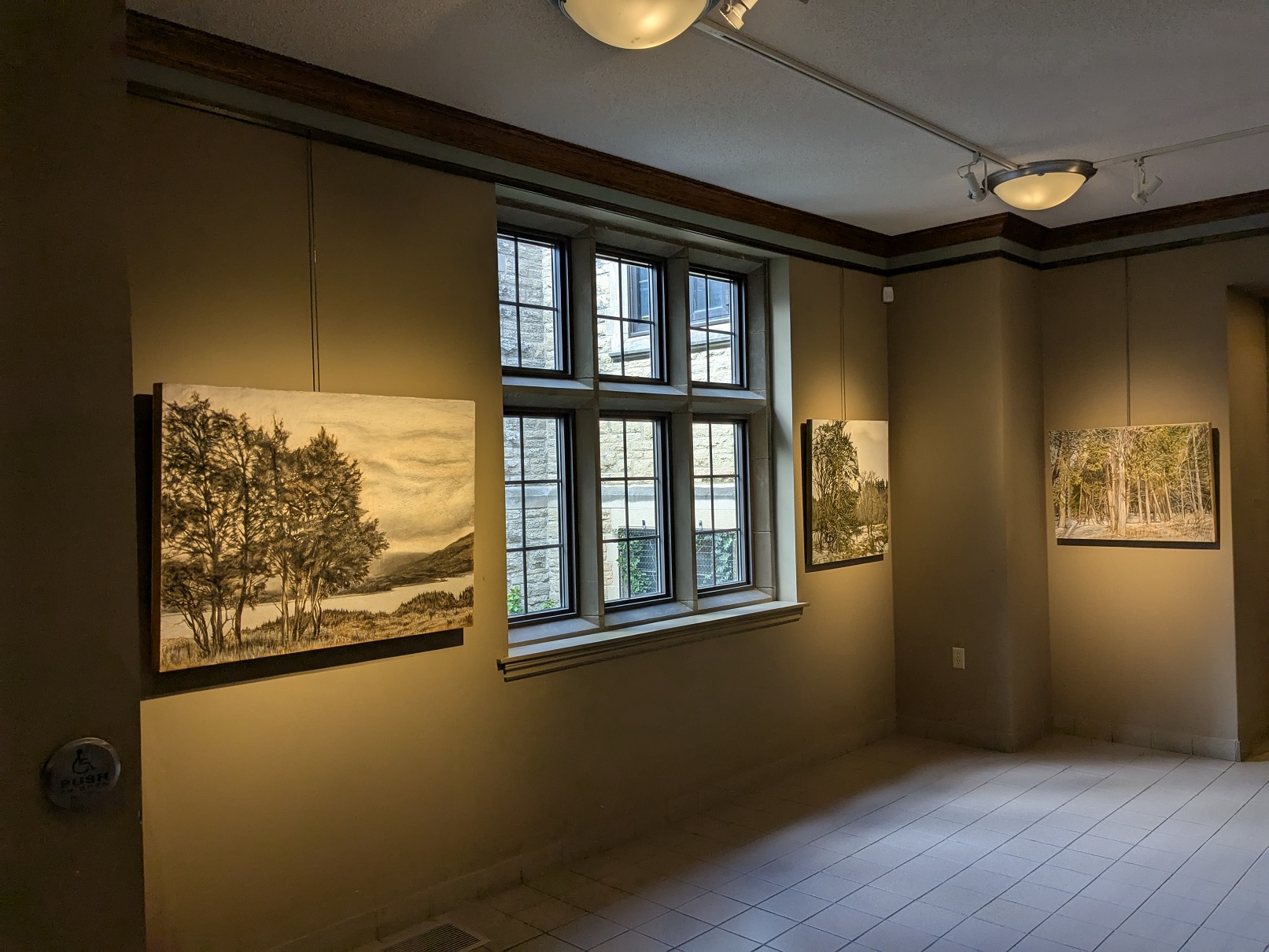
Installation view of Hugh Alcock, Into the Clearing at Yorkminster Park Gallery
Alcock does not offer the kind of landscapes we have grown accustomed to; no expansive vistas, no theatrical skies. Instead, he gives us the thickets landscape, with the bark, the undergrowth. He brings us face to face with the density of the forest, with its entanglements and obscurities. He draws our eyes in to linger on trunks, on roots, on the places where one branch splits into two, then two into four, proliferating geometries that threaten to overwhelm. Yet his hand is careful. These are drawings, not paintings. Built up with lines upon line, they become a structure of attention made visible.
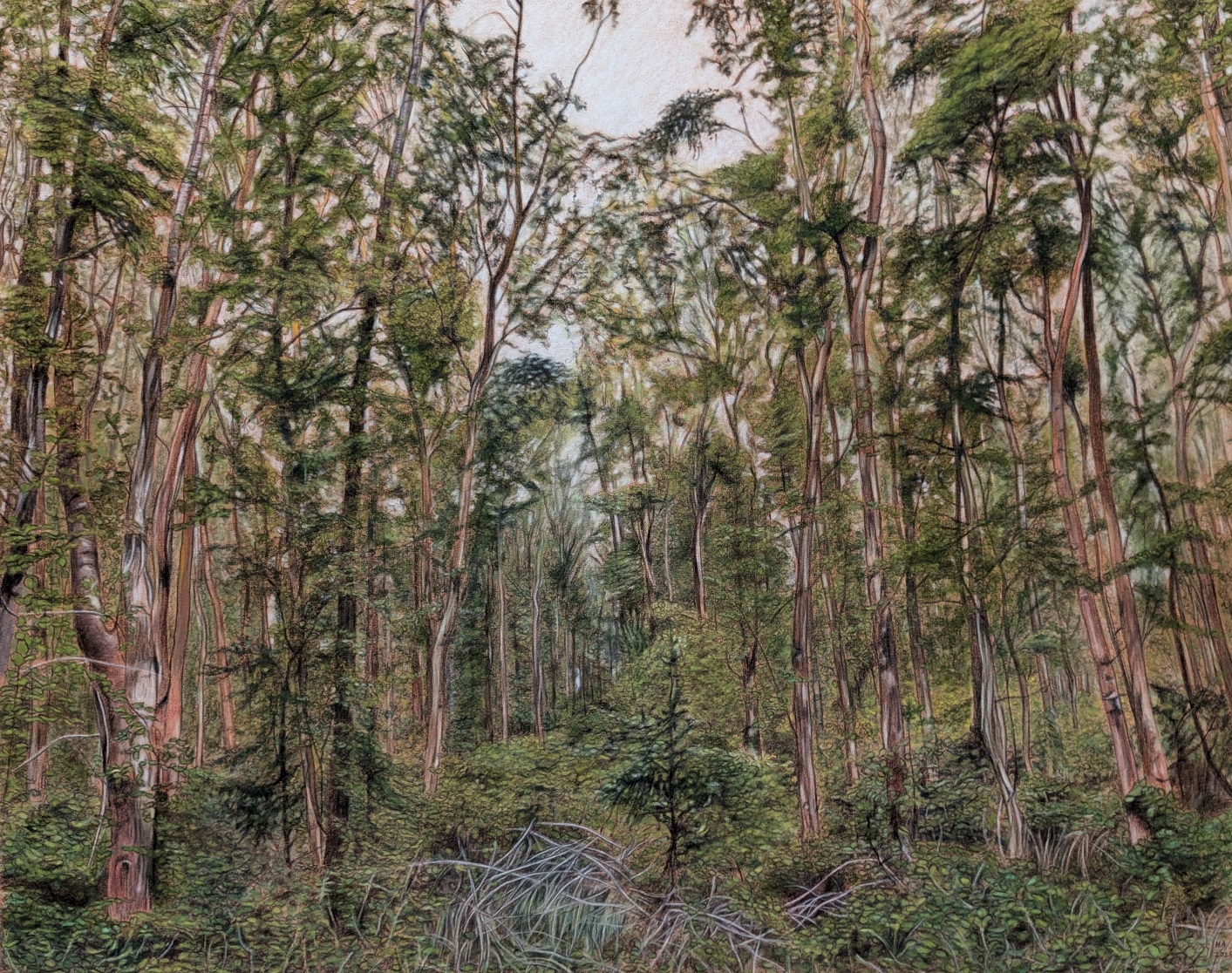
Woodland, 2025, pastel and charcoal on canvas, 48 in x 60 inches
The artworks are made with charcoal and pastel on canvas and board. The technique results in lines that are softer than pen or pencil but more linear than paint. Alcock uses a restrained palette. Browns like earth, greys like weathered stone, greens so subdued they almost vanish. Alcock is not interested in seducing us with colour. He wants us to notice form, rhythm, pattern, the slow architectures of nature.
Trees are what is depicted in Alcock’s artwork. But perhaps we can say that the true subject of the work is the contemplation of these trees. The artwork not only describes what the trees look like, but what it’s like to look at trees. In his artist’s statement, he writes of their quiet presence, their infinite variety, their capacity to shift appearance with light, season, and weather. Their bark is rendered as ridged lattices, their branches as unfolding networks. One can trace his attention as it moves through these structures. The drawings record not only what he saw, but the act of seeing itself.
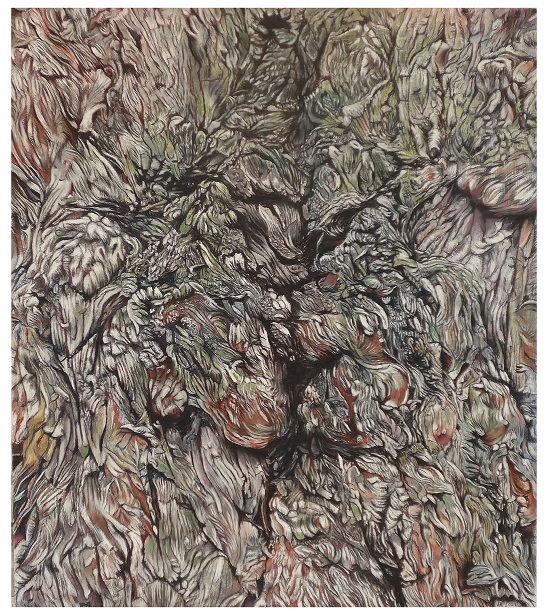
Study of Willow Bark: In Memoriam, 2020, pastel and charcoal on wood panel, 48 x 42 inches
These intricate drawings invite us to experience a sensory dimension that extends beyond the visual. Alcock has written that he hopes viewers not only see but also “listen for the rustle of the trees, smell the fragrances in the air, and feel the spikiness all around or the cold ground underfoot.” This synesthetic invitation reverberates through the work. The density of mark-making makes one think of sound textures of tactile resistance, of rough and irregular surfaces. You almost catch the dampness of moss, the chill of shaded soil, the faint resinous odor of pine.
There is tension in these works. They oscillate between enclosure and release, between the density of the underbrush and the promise of air. Often what is most powerful is what is barely there: the space between branches, the fragment of light beyond, the suggestion of depth that dissolves into shadow. Alcock makes absence as present as substance. The viewer senses both the weight of the forest and the fragile openings within it.
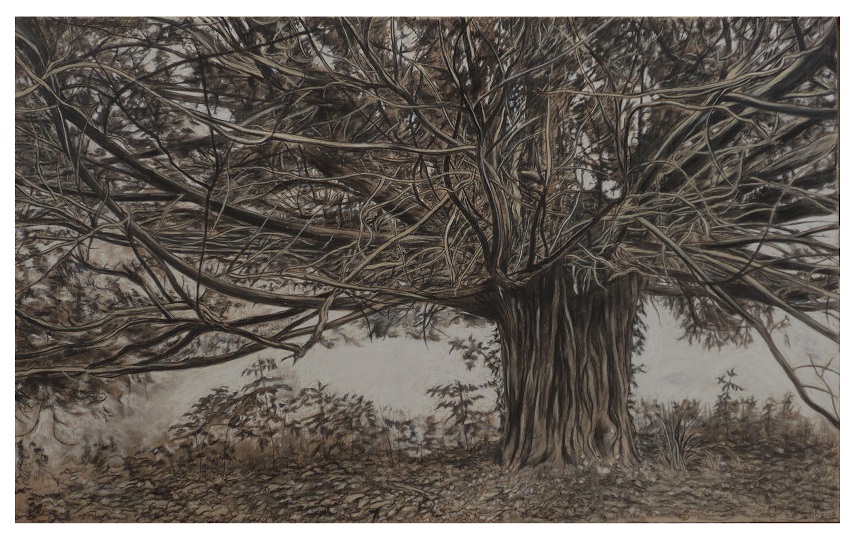
Yew, Churchyard, 2022, pastel and charcoal on wood panel, 30 x 48 inches
What makes Alcock’s work unusual in our current climate of overstimulation is its insistence on patience. These are not images you can skim. They resist the instant hit of spectacle. They require time, the way a forest requires wandering. If you give that time, the reward is real. You begin to see how each branch moves, how bark curves and cracks, how form is never static but always unfolding.
Mikael Sandblom
Images are courtesy of the artist.
*Exhibition information: Hugh Alcock, Into the Clearing, September 13 – October 30, 2025, Yorkminster Park Gallery, 1585 Yonge Street, Toronto. Gallery hours: Saturday 12 – 3pm, Sunday 10am – 11am and 12:15 – 1pm.